The role of a CTPO — Chief Technology and Product Officer
Alexander Stasiak
Apr 07, 2026・13 min read
Table of Content
Key Takeaways
What Is a CTPO (Chief Technology & Product Officer)?
How the CTPO Role Differs from CTO and CPO
CTPO Job Description and Key Responsibilities
Core Domains of the CTPO Role
Product Vision and Customer Value
Technology Strategy and Emerging Technologies
Operating Model, Execution, and Data-Driven Decision Making
Organization Design, Talent, and Culture
CTPO KPIs and Scorecard
Using Metrics Without Becoming a Bureaucracy
When a CTPO Role Makes Sense-and When It Doesn’t
Typical Reporting Lines and Team Structure Under a CTPO
Essential Skills and Background for a Successful CTPO
From CTO or CPO to CTPO: Closing the Gaps
How a New CTPO Should Use Their First 90 Days
FAQ
Is a CTPO higher than a CTO or CPO?
What size company should consider hiring a CTPO?
How is CTPO compensation typically structured?
Can a CTPO role be part-time or fractional?
What are warning signs that the CTPO model isn’t working?
Key Takeaways
- A CTPO, also called CPTO, combines the chief technology officer and chief product officer roles into one executive accountable for product outcomes and technology execution.
- The role of a ctpo is to align product vision, engineering strategy, architecture, and data driven decision making around customer value and business impact.
- The model works best in product-led SaaS, gaming, fintech, and AI companies where technology and product development are inseparable.
- CTPOs need essential skills across product strategy, systems architecture, leadership skills, business acumen, and metrics.
- As company size grows beyond roughly 300–500 people or multiple product lines, many organizations split the role back into separate leaders.
A CTPO is not just a “CTO plus roadmap owner.” The Chief Technology and Product Officer (CTPO) role is gaining traction, especially in fast-moving startups, as it eliminates silos between technology and product, allowing for faster decision-making and better alignment.
The CPTO model is gaining popularity in product-led organizations, where technology is inseparable from the product, allowing for faster innovation and alignment between product and technology teams.
What Is a CTPO (Chief Technology & Product Officer)?
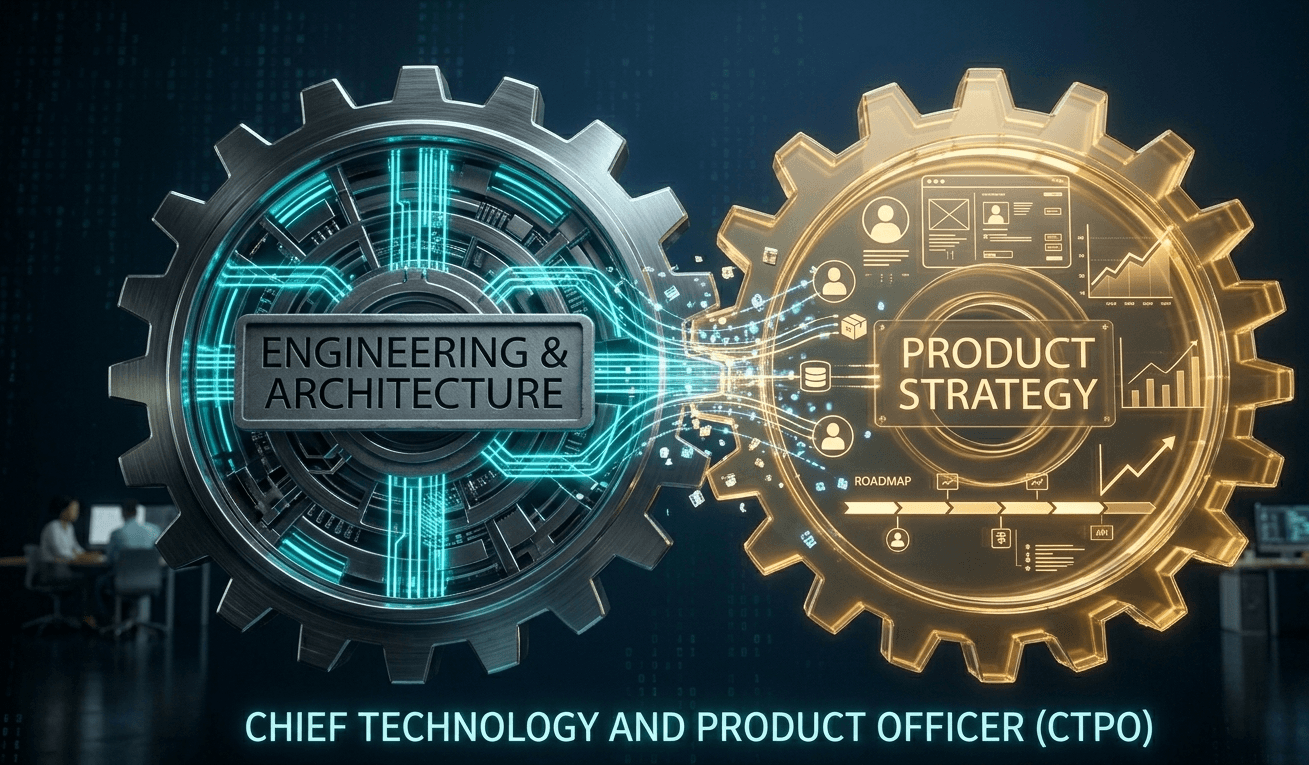
A CTPO, or CPTO, is a C-suite technology officer who owns both the product strategy and the technical side of execution. The CPTO (Chief Product and Technology Officer) role combines the responsibilities of both the CTO and CPO, focusing on aligning product strategy with technology execution.
In simple terms, the CTPO blends the classic chief technology officer cto focus on architecture, platforms, security, information technology, and emerging technologies with the chief product officer focus on product vision, product roadmaps, customer needs, market fit, and customer value.
The CTPO typically reports to the CEO, although a cto report or product update may also go to the board. This role is common in tech companies founded after 2010, especially B2B SaaS, fintech, AI-native platforms, and smaller companies where strategy and delivery need to move together.
The title may appear as CTPO or CPTO. The order changes, but the responsibility is the same: align technology and product so product ideas become reliable, useful, successful products.
How the CTPO Role Differs from CTO and CPO
Traditional executive teams may include a CTO, CPO, and CIO. The cto role usually owns technical execution, while the CPO owns the customer and product direction. The CIO often owns internal systems and enterprise information technology.
A CTO primarily focuses on technology strategy and engineering execution, ensuring that the technology stack is robust and aligned with business goals, while a CPO focuses on product strategy and customer needs. CTOs oversee IT and infrastructure management, maximizing operational efficiency of internal networks and software systems.
The CTO defines the long-term technical roadmap, ensuring the tech stack is scalable, secure, and aligned with market demands. CTOs implement security measures and compliance audits to protect intellectual property and customer data. CTOs initiate research and development by evaluating and integrating emerging technologies to enhance products or services. A strategic CTO can optimize technology budgets for increased productivity and reduced long-term operational costs.
The CPO is responsible for defining the product roadmap and ensuring that the product delivers value to users, while the CTO is responsible for the technical aspects of product development, such as architecture and implementation. The CPO also works on pricing, packaging, discovery, customer satisfaction, and avoiding feature factory thinking.
A CTPO combines both. A CPTO is responsible for aligning product strategy, roadmap priorities, architecture decisions, and delivery capacity under one decision-making system, which reduces friction and improves speed. Product-engineering alignment minimizes wasted effort and mismatched expectations between product and engineering teams.
The difference is accountability. Instead of two executives negotiating priorities, one leader owns the trade-off.
However, while the CPTO role can streamline decision-making in startups, it may not be suitable for larger organizations with complex structures, where dedicated CTO and CPO roles are often more effective.
CTPO Job Description and Key Responsibilities
A realistic 2026 job description for a growth-stage SaaS company might read like this:
The CTPO leads technology and product development, owns the 3–5 year product and technology strategy, and ensures execution aligned with business strategy. The role connects customer insight, technical feasibility, and delivery capacity.
Key responsibilities include:
- Define product strategy, including overarching product direction, prioritizing market opportunities, and creating customer value roadmaps.
- Own technology oversight by guiding technical infrastructure, ensuring scalability, security, and long-term architectural health of products.
- Lead cross functional teams across product management, software development, design, data, AI, and research.
- Balance product feature requests against technical debt, maintenance, and cost efficiency.
- Build a repeatable system for decision making, delivery, measurement, and learning.
A CPTO’s job includes turning strategy into a repeatable decision-and-delivery system, ensuring that product bets, technical direction, and execution capacity remain aligned week after week.
The CPTO leads cross-functional teams, including engineers, product managers, and designers, to create innovative and successful products by blending technical expertise with an understanding of product strategy and market needs.
Core Domains of the CTPO Role
In practice, the role clusters into recurring weekly domains. A successful cto or CTPO does not personally approve every task. They set guardrails, choose which decisions matter most, and delegate the rest.
Product Vision and Customer Value
The CTPO leads or co-creates product vision with the CEO and commercial leaders. This means shaping product strategy around real customer problems, not just internal product ideas.
Product strategy includes defining overarching product direction, prioritizing market opportunities, and creating customer value roadmaps. Strong CTPOs use quarterly strategy reviews, customer interviews, cohort analysis, and sales feedback to connect the roadmap to market needs.
They also prevent feature factory behavior. Instead of prioritizing features because a loud customer asked, they focus on activation, retention, NRR, customer experience, and business outcomes.
Technology Strategy and Emerging Technologies
This is where traditional chief technology officer work expands into the broader CTPO mandate. cto focuses on architecture, engineering teams, infrastructure, system reliability, and security; the CTPO connects those choices to product value.
Technology oversight involves guiding technical infrastructure, ensuring scalability, security, and long-term architectural health of products. The CTPO decides whether the company should adopt new technologies such as generative AI, edge computing, automation, or MLOps.
The best CTPOs do not chase every technological trends headline. They run small experiments with clear success criteria, then decide whether to scale, pause, or stop. This helps the company stay ahead without wasting engineering capacity.
Operating Model, Execution, and Data-Driven Decision Making
In agile environments, having a CPTO can enhance the ability to quickly align product and technology decisions, which is crucial for maintaining momentum in fast-paced development cycles.
A CTPO creates one operating model: shared roadmaps, weekly portfolio reviews, architecture forums, and quarterly strategic planning. This keeps product teams and development teams working from the same facts.
Useful metrics include:
| Area | Example metrics |
| Product value | Adoption, activation, ARR from new features, customer satisfaction |
| Delivery | Lead time, deployment frequency, roadmap predictability |
| Reliability | Uptime, SLO attainment, MTTR, change failure rate |
| Risk | Time-to-patch, audit findings, security incidents |
| Efficiency | Cloud cost per customer, build times, cost efficiency |
Data driven decision making should guide trade-offs, not create dashboard theater. A/B testing, cohort analysis, engineering efficiency metrics, and product analytics should feed investment choices.
Organization Design, Talent, and Culture
CTPOs shape team topology: product squads, platform teams, data teams, design groups, and shared services. They hire senior leaders, coach managers, and decide when a VP Product or VP Engineering should take more ownership.
Aligning product and technology teams is a significant challenge for CPTOs, necessitating strong communication, collaboration, and a culture of shared ownership.
Concrete moves include changing reporting lines, introducing joint “Builders” meetings, clarifying decision rights, and making sure no single discipline dominates. The CTPO must communicate effectively with software developer teams, a tech lead, a senior engineer, product managers, designers, executives, and non technical stakeholders.
CTPO KPIs and Scorecard
A CTPO needs one scorecard that measures both product outcomes and technology health. According to CTO Academy, this unified view is one reason the CTPO model improves alignment.
Good KPI categories include:
- Product value: activation, retention, NPS, expansion revenue, business impact.
- Delivery performance: lead time, deployment frequency, release quality.
- System reliability: uptime, latency, incident frequency, MTTR.
- Security and risk: time-to-patch, compliance coverage, privacy incidents.
- Cost and efficiency: infrastructure spend, engineering capacity mix, unit economics.
Using Metrics Without Becoming a Bureaucracy
Metrics can slow teams down if every decision needs a report. Keep the set small, focus on leading indicators, and retire metrics that no longer guide action.
For example, if uptime drops while feature output rises, the CTPO may rebalance capacity toward platform work. If adoption is weak despite high delivery velocity, the issue may be discovery, not software development.
The point is clarity and faster decision making, not micromanagement.
When a CTPO Role Makes Sense-and When It Doesn’t
Combining the CPTO role with other leadership roles is particularly beneficial in resource-constrained environments, such as startups, where streamlined decision-making is essential.
The CPTO model is particularly beneficial in resource-constrained environments, such as startups, where streamlined decision-making is crucial for rapid growth and innovation.
The model is ideal in early stage startups, post-market-fit scale-ups, and product-led companies with one primary product line. The CPTO model is particularly beneficial in environments where product and technology decisions are inseparable, such as in SaaS, gaming, and AI-driven platforms, allowing for faster decision-making and improved alignment.
While combining the CPTO role can lead to improved alignment and faster decision-making, it may not be suitable for complex organizational structures or heavily regulated industries where specialized focus is required.
Good split triggers include:
- Headcount growing beyond roughly 300–500 people.
- Multiple product lines, new markets, or regional business units.
- Security, compliance, or regulatory work becoming a full-time leadership need.
- One person being unable to give enough attention to both customer value and technical excellence.
As companies grow, the demands on both product and engineering increase, making specialization unavoidable, which may lead to a separation of the CPTO role back into distinct CTO and CPO positions.
Typical Reporting Lines and Team Structure Under a CTPO
In smaller companies, product management, engineering, design, data, and platform operations often report directly to the CTPO. In larger organizations, VP-level leaders run each function.
Security, IT, and data science may report directly or work through dotted-line relationships. Pricing may be co-owned with revenue leaders. The key is clarity on what the CTPO owns, co-owns, and influences.
A simple structure might look like:
- CTPO
- VP Engineering
- VP Product
- Head of Design
- Head of Data/AI
- Platform or DevOps lead
Essential Skills and Background for a Successful CTPO
The CPTO role requires a broad understanding of both product and technology, making it challenging to balance these two domains effectively.
Essential skills include:
- Strategic thinking and strategic planning.
- Systems architecture literacy and technical expertise.
- Product management and commercial judgment.
- Business acumen and understanding of business opportunities.
- Leadership skills across cross functional teams.
- Ability to connect technology initiatives to business goals.
- Clear communication with executives, teams, customers, and investors.
Common career paths include a CTO broadening into product, a chief product leader developing technical depth, or an engineering background leader who has worked as a software developer, tech lead, or senior engineer before moving into product-facing roles.
From CTO or CPO to CTPO: Closing the Gaps
Most CTPOs start closer to either the chief technology officer or chief product officer side.
For CTOs, the gaps are usually customer research, market analysis, packaging, pricing, and storytelling around customer value. CTOs are responsible for aligning technological vision with business goals and bridging the gap between leadership and technical teams. CTOs enhance customer experience by ensuring digital products are user-friendly and responsive to consumer needs.
For CPOs, the gaps are usually architecture, DevOps, security, scalability, and realistic engineering constraints. Good development actions include shadowing the other discipline, co-leading roadmap reviews, taking security or product discovery courses, and running cross-functional initiatives before taking the title.
Trust matters as much as knowledge. Product teams must believe the CTPO understands market reality, and engineering teams must believe the CTPO respects technical challenges.
How a New CTPO Should Use Their First 90 Days
The first 90 days should diagnose before changing everything.
Days 1–30:
- Review current product roadmaps, architecture, metrics, and team health.
- Meet customers, executives, engineering teams, product managers, and support.
- Identify delivery bottlenecks, technical debt, and market gaps.
Days 31–60:
- Create one shared roadmap across product and technology.
- Clarify decision rights and escalation paths.
- Start a weekly portfolio review and architecture review.
Days 61–90:
- Introduce a lightweight CTPO scorecard.
- Adjust team structure only where misalignment is obvious.
- Set 6–12 month product and technology bets.
Common failure modes for CPTOs include becoming a bottleneck in decision-making, over-indexing on technology excellence at the expense of customer value, and allowing product and engineering teams to operate on different cadences.
The safest approach is to improve the operating system first, then make larger organizational changes.
FAQ
This FAQ answers common questions founders, candidates, and CEOs ask about the role.
Is a CTPO higher than a CTO or CPO?
A CTPO is usually a peer-level C-suite role, not a role “above” a CTO or CPO. In companies with a CTPO, there is usually no separate chief technology officer or chief product officer; VP-level leaders often report into the CTPO.
What size company should consider hiring a CTPO?
Companies between roughly 20 and 300 employees with one main product line are the most common fit. Earlier than that, founders often cover the early stages informally; beyond a few hundred people, complexity may require separate leaders.
How is CTPO compensation typically structured?
CTPO compensation usually includes base salary, bonus, and equity such as options or RSUs. One industry summary reported average CPTO base salary around US$220,000 in late 2025 or early 2026, but the job market varies by geography, funding stage, and industry.
Can a CTPO role be part-time or fractional?
Yes. Fractional CTPOs are increasingly common in startups that need senior guidance but cannot justify a full-time executive. They usually focus on strategy, operating model, and mentoring while internal managers run daily delivery.
What are warning signs that the CTPO model isn’t working?
Warning signs include slow decisions, CTPO burnout, repeated quality issues, security incidents, frustrated teams, or missed market opportunities. If these continue, the board may need to narrow the scope, add senior leaders, or split the role into separate CTO and CPO positions.
Digital Transformation Strategy for Siemens Finance
Cloud-based platform for Siemens Financial Services in Poland

You may also like...

Why Your Internal Knowledge Base Is Failing (And What To Do About It)
Siloed, outdated, and unsearchable documentation quietly drains your team's velocity every day. This article diagnoses why internal knowledge bases fail and lays out a practical roadmap using enterprise search, AI, and a document-first culture.
Alexander Stasiak
Jun 27, 2026・10 min read

The Role of a CTO — Chief Technology Officer
The Chief Technology Officer is no longer just the senior engineer with the biggest title — they are the executive who turns technology into business value, revenue, and competitive advantage. From writing early code in a 20-person startup to setting AI governance in a global enterprise, the CTO role spans technology strategy, platform architecture, security, team leadership, and budget decisions. This guide breaks down what CTOs actually do, the skills that separate good from great, how the role differs from CIO and CPO, and the realistic 12–20 year career path to get there.
Alexander Stasiak
Apr 06, 2026・13 min read

Tech Lead Roles and Responsibilities
The tech lead has become one of the most indispensable — and most misunderstood — roles in modern software teams. Often confused with engineering managers, tech leads are senior individual contributors who own technical direction, delivery quality, and team enablement, all while staying hands-on with code. This guide breaks down what the role actually entails in 2026: core responsibilities, essential skills, a realistic day-in-the-life, how the role differs across startups, enterprises, and agencies, and a practical roadmap for engineers ready to grow into it.
Alexander Stasiak
Apr 28, 2026・12 min read
Ready to centralize your know-how with AI?
Start a new chapter in knowledge management—where the AI Assistant becomes the central pillar of your digital support experience.
Book a free consultationWork with a team trusted by top-tier companies.