Autonomous Food Delivery

Table of Content
Compact sidewalk robots now deliver millions of meals, groceries, and small packages across cities and campuses worldwide. Autonomous food delivery has matured from experimental pilots into a scalable logistics solution—one that slashes costs, cuts emissions, and operates around the clock. Here’s what businesses need to know about deploying this technology in 2026.
Autonomous food delivery in 2026: where we are now
The market has reached a tipping point. Starship Technologies operates in over 270 cities and college campuses globally, having completed more than 9 million deliveries across 19 million kilometers. Grubhub launched its partnership with Avride to deploy autonomous delivery robots in Jersey City and other U.S. cities, while Ohio State University runs one of the largest campus fleets serving thousands of students daily.
These delivery robots are no longer confined to controlled environments. They now navigate sidewalks in mixed-use districts, residential neighborhoods, and dense urban blocks. The shift from niche pilot programs to mainstream deployment signals that robotic delivery is ready for scale.
At Startup House, we design and build the software and AI layers that power these systems—from routing algorithms and consumer apps to fleet dashboards that keep operations running smoothly.
How autonomous food delivery robots work
Modern sidewalk robots measure roughly 50 cm long, 45-50 cm wide, and 30-40 cm high. They move at speeds of 5-8 km/h and carry payloads of 20-25 kg—enough for six large pizzas plus drinks.
Navigation and sensors:
- High-resolution cameras (up to 12 per unit) identify traffic signals, pedestrians, and objects
- LiDAR technology creates detailed 3D maps for distance and depth measurement
- Ultrasonic and radar sensors detect close-range moving objects to prevent collisions
- GPS provides global positioning with centimeter-level precision
These robots utilize a combination of sensors to detect obstacles, navigate their environment, and make real-time decisions. AI and machine learning enable them to interpret environmental data and determine efficient routes — typically backed by mapping and geospatial layers built on platforms like Mapbox-powered navigation, which Startup House has integrated into mobile and web products requiring real-time location intelligence. They recognize traffic light signals and assess the speed and direction of approaching vehicles before crossing roads safely.
Delivery robots are programmed to operate at a maximum speed of 8 km/h to minimize accident risk. They connect via LTE/5G to cloud backends for routing updates, telemetry, and remote assistance. With IP66 water resistance and suspension handling 6-inch obstacles, they operate 24/7 in rain and light snow.
Key use cases: from campuses to dense urban blocks
Adoption follows a clear pattern: controlled environments first, then outward expansion.
University campuses remain the proving ground. U.S. campuses log over 100,000 robot deliveries annually, with students ordering hot meals and late-night snacks through Uber Eats integrations and campus dining apps.
Residential and mixed-use districts represent the growth frontier. Typical deployments handle grocery delivery and restaurant orders within a 1-3 mile radius, with average delivery time of approximately 15 minutes from store to door.
Corporate and industrial campuses use robots for canteen food, office supplies, and inter-building logistics—locations where cars cannot efficiently operate.
Robots unlock access to gated communities, pedestrian-only zones, and sprawling campus interiors. They also improve food access for individuals with mobility limitations who may struggle to visit physical stores.
Benefits for restaurants, grocers, and delivery platforms
Last mile delivery accounts for 50-70% of total logistics costs—making it the most expensive segment to optimize.
| Benefit | Impact |
| Cost reduction | Delivery robots can reduce last-mile costs by 30-50% by eliminating human driver expenses |
| Energy efficiency | Electric-powered robots use energy equivalent to boiling a kettle for one cup of tea per delivery |
| Reliability | Autonomous robots operate 24/7 without fatigue or breaks |
| Weather resilience | Robots operate in various weather conditions including rain and snow |
| Emissions | Drastically reduced greenhouse gas emissions and noise pollution versus gas-powered vehicles |
Operational flexibility matters too. Fleets scale without hiring surges, and robots work late nights and bad weather when courier supply drops 50-70%. The technology is sustainable, convenient, and increasingly affordable at scale.
Startup House builds software that lets restaurants and grocers integrate robots into existing websites, apps, and POS systems — minimizing friction while maximizing efficiency. Our work on MyFoodOffice, a B2B food ordering and delivery management platform, shows how the right digital layer turns fragmented food operations into a streamlined workflow.
Safety, privacy, and public acceptance
Public reaction mixes enthusiasm with legitimate concerns about sidewalk space and safety.
Safety features:
- Multi-layer sensor systems for 360-degree awareness
- Capped speeds designed for pedestrian areas (comparable to fast walking pace)
- Emergency stop protocols triggered by ultrasonic sensors
- Road-crossing logic enabling 100,000+ safe crossings daily across fleets
Autonomous vehicles provide contactless delivery options that enhance safety and hygiene—important for disease prevention. Remote operators intervene in unusual situations without continuous manual control.
Limitations to acknowledge:
- Inclement weather like heavy rain and snow can impair sensors
- Robots face navigation barriers from stairs and steep gradients
- Delivery robots are vulnerable to theft, vandalism, and tampering while in transit
- Customer interaction issues arise because most robots require customers to meet them at the curb
Privacy measures include real-time face and license plate blurring, with platforms storing only anonymized sensor data for model training.
Core software and AI building blocks
The digital layers powering autonomous delivery require specialized expertise. Here’s what the software stack includes:
- Navigation algorithms: Path planning, obstacle avoidance, and localization using HD maps and live sensor data. AI processes camera data to recognize obstacles and determine efficient routes in real-time.
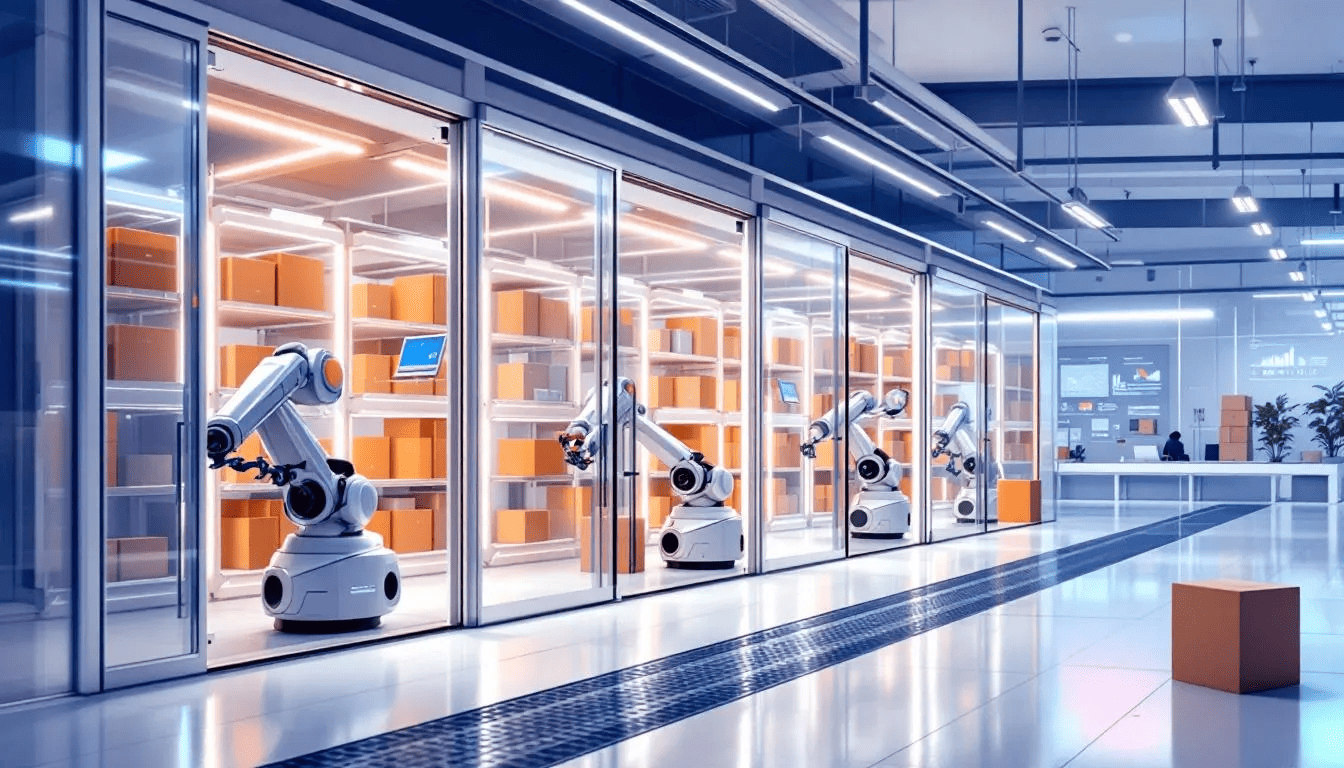
- Fleet management systems: Centralized dashboards monitoring hundreds of robots, battery status, task queues, and maintenance schedules
- Ordering apps: Consumer-facing mobile apps and web portals for placing orders, tracking robots on maps, and unlocking cargo with secure codes
- Store integrations: Connectors to POS systems and kitchen displays for automatic dispatch when orders are ready
- Analytics engines: AI analyzing delivery times, heatmaps, and failure modes to refine routes and capacity planning
Each of these layers depends on a strong foundation in AI and data science — the routing models, demand forecasts, and anomaly detection systems that turn raw sensor and order data into operational decisions at fleet scale.
These robots utilize a sophisticated suite of hardware and software, with high-tech sensors and AI for navigation and obstacle avoidance. As an AI software house, Startup House designs these digital layers from MVP pilots to enterprise-grade, globally deployed platforms.
Implementation roadmap for businesses
A phased approach reduces risk while validating demand:
Phase 1 – Feasibility: Analyze order density, delivery radiuses, labor costs, and local regulations. Robots work best with 50+ daily orders per square kilometer within 3-mile radii.
Phase 2 – Pilot design: Start with 1-3 locations and a limited fleet. Collaborations between delivery robot manufacturers and retailers, campuses, and delivery apps are essential for cost-effective solutions.
Phase 3 – Software integration: Connect robots to ordering channels via APIs. The integration of autonomous delivery robots into existing platforms is a growing trend enabling seamless operations.
Phase 4 – Operations training: Create playbooks for kitchen staff and support teams. Train employees on loading procedures and customer communication.
Phase 5 – Scaling: Expand zones and fleet size once KPIs are met. Partnerships like Grubhub’s expansion with Avride demonstrate the model for marketplace integration.
Startup House supports each phase from product discovery through backend development and long-term scaling.
Regulation, infrastructure, and city collaboration
Regulation can accelerate or stall deployment dramatically. Cities are still creating regulations for sidewalk robots, with some areas banning them for safety concerns.
Key regulatory factors:
- Speed limits (typically 8-10 km/h) and weight restrictions (under 30 kg)
- Permitting requirements and public liability insurance
- Accessibility rules ensuring pedestrian priority at ramps and curb cuts
- Widespread adoption concerns about job displacement for human delivery drivers
Urban infrastructure quality matters. Well-maintained sidewalks, clear crosswalks, and designated drop-off zones improve success rates. Robots can handle low curbs and speed bumps but struggle with broken pavement.
Data-sharing partnerships help cities and operators share anonymized traffic data to improve infrastructure planning. Software must adapt to city-by-city rules through geo-fencing and time-window controls—rule engines Startup House designs for flexible compliance.
Future of autonomous food delivery and how to get started
By 2030, expect larger fleets, hybrid drone and sidewalk robot models, and deeper AI optimization integrated with smart buildings. Robots will expand from food and groceries into pharmaceuticals, convenience retail, and internal corporate logistics.
Autonomous delivery is becoming a standard option alongside human couriers, especially in dense urban and campus environments. The world of last-mile logistics is being reshaped by this innovation.
Ready to explore autonomous food delivery? Contact Startup House to discuss an autonomous delivery MVP, integration with your existing apps, or AI-driven optimization of your current last-mile operations.
How this article was made. Drafted with AI assistance, then fact-checked and edited by our team. Editorial responsibility: Startup Development House sp. z o.o. Read our AI content policy
Digital Transformation Strategy for Siemens Finance
Cloud-based platform for Siemens Financial Services in Poland

You may also like...

Flutter Food Delivery App: From Idea to Production-Ready Platform
Building a Flutter food delivery app isn’t just about screens—it’s logistics, payments, real-time tracking, and scalability.
Alexander Stasiak
Jan 29, 2026・5 min read

AI Agents for Predictive Maintenance and Asset Reliability
How autonomous agents read vibration, thermal and acoustic data to predict failures weeks ahead — and act on them without waiting for a human.
Alexander Stasiak
Aug 29, 2026・9 min read
Business Intelligence Services & Solutions
Most organisations have more data than insight, and the gap is architectural rather than analytical. This guide explains how business intelligence services and solutions turn fragmented data into a strategic asset, and how modern BI differs from traditional reporting. It reviews industry-specific applications, provides a step-by-step implementation framework, and names the pitfalls that stall BI projects. The final sections cover AI-augmented analytics and how to future-proof a data strategy.
Alexander Stasiak
Jul 15, 2026・8 min read

Why Knowledge Base Content Becomes Outdated
Your knowledge base was a source of truth once. Now it's a liability. Products have changed, teams have restructured, and the documentation your employees and customers rely on is silently giving wrong answers.
Alexander Stasiak
Mar 17, 2026・11 min read

AI Agents for Factory Workflow Optimization
How autonomous agents orchestrate the whole factory — resolving bottlenecks, scheduling maintenance and reallocating resources before output suffers.
Alexander Stasiak
Sep 28, 2026・8 min read

AI in Fintech: Startup House Projects, Lessons, and Outcomes
Fintech customers expect consumer-grade speed, while regulators expect bank-grade control. This article shows how Startup House has handled that tension in three projects: automated 24/7 credit decisions for Siemens Financial Services, a cyber risk platform that grew revenue 150% in a year, and a climate fintech team for CHOOOSE assembled in 2 weeks. Each project comes with the lesson it taught us. The article closes with five rules for AI in finance, from grounding every answer in verified data to designing tenant isolation into the architecture.

Marek Pałys
Oct 01, 2026・5 min read
Recently added

How Startup House Cut Leasing Applications to 2 Minutes for Siemens Financial Services
Leasing used to mean paperwork, manual credit checks, and decisions that waited for office hours. For Siemens Financial Services Poland, Startup House replaced that with SimplyLease Online: an application customers complete in about 2 minutes and an automated credit decision delivered in about 7, at any hour. This case study shows how the platform was built within Siemens Group security standards, how it connects to Siemens systems and external data providers, and what a partnership running since 2016 has delivered. It closes with three lessons that apply to almost any financing or lending product.
Alexander Stasiak
Oct 06, 2026・5 min read

How a Cybersecurity Platform Serving Fortune 500 Clients Cut Onboarding by 95% with an AI Agent Built by Startup House
A cyber risk platform trusted by Fortune 500 companies had a familiar problem: customers respected it but opened it once a quarter, and onboarding took 45 minutes of guided setup. Startup House built Aria, an AI agent embedded inside the product, with a four-layer interface that serves board members, CFOs, and CISOs in one panel. Onboarding dropped by 95% to under 2 minutes, data exploration became fully self-serve, and the platform turned into a daily decision-support tool. This case study explains the interface, the tenant-isolation architecture, and why none of it required touching the platform's core codebase.
Marek Pałys
Oct 05, 2026・5 min read

AI and Digital Projects by Startup House: 5 Measurable Outcomes in Numbers
Claims are easy in software development, so this article sticks to numbers. It walks through five outcomes from Startup House client projects, from a 95% cut in onboarding time with an embedded AI agent to a 40% reduction in development costs for Omnipack. Each section says what kind of work produced the number and links to the public case study behind it. The closing section names three patterns these projects share, worth borrowing whether or not you work with us.
Alexander Stasiak
Oct 04, 2026・5 min read

Healthtech Software Development at Startup House: Compliance-First Projects and Results
In healthcare software, compliance is either an architecture decision or a retrofit. This article shows what designing it in from day one looks like across three Startup House projects: a sales platform for Siemens Healthineers active in more than 60 countries, a dementia care MVP shaped by 7 user testing sessions with patients and caregivers, and Doogie, a HIPAA-grade AI showcase built in 2 months. It also explains how RAG keeps clinical AI answers traceable to verified sources, and why patient data is never used to train models. For MedTech companies and health SaaS platforms, it is a practical look at what compliance-first engineering means beyond the label.
Marek Pałys
Oct 03, 2026・5 min read

Edtech Development at Startup House: What We've Built and What It Changed
EdTech platforms fail for UX reasons more often than technical ones: learners drop off, content doesn't scale, and ROI stays invisible. This article shows how Startup House avoids that with phased delivery and real user testing, using two projects as proof. Graspify went from a bold idea to a microlearning platform that trained hundreds of employees during a corporate event, and LITTLEWINE got an investor-ready scope from 10 user interviews in 2 weeks. It also covers AI learning tools that answer only from approved content and can go live in as little as 2 weeks.
Alexander Stasiak
Oct 02, 2026・5 min read
AI in Fintech: Startup House Projects, Lessons, and Outcomes
Fintech customers expect consumer-grade speed, while regulators expect bank-grade control. This article shows how Startup House has handled that tension in three projects: automated 24/7 credit decisions for Siemens Financial Services, a cyber risk platform that grew revenue 150% in a year, and a climate fintech team for CHOOOSE assembled in 2 weeks. Each project comes with the lesson it taught us. The article closes with five rules for AI in finance, from grounding every answer in verified data to designing tenant isolation into the architecture.
Marek Pałys
Oct 01, 2026・5 min read
Ready to centralize your know-how with AI?
Start a new chapter in knowledge management—where the AI Assistant becomes the central pillar of your digital support experience.
Work with a team trusted by top-tier companies.


