Mcp And The Future Of AI Integration: What Ctos Need To Know In 2026
Alexander Stasiak
Jun 24, 2026・14 min read
Table of Content
Key Takeaways
What is the Model Context Protocol?
The Strategic Value of MCP for Your CTO AI Strategy
Reducing Tech Debt Through Standardisation
Improving Time-to-Market for AI Products
Architectural Deep Dive: How MCP Functions
Key Components of MCP Architecture
The Future of AI Integration in 2026: Beyond Chatbots
High-Fidelity Contextual Awareness in AI Systems
Dynamic UI Generation with MCP
Practical Challenges and Risks of Adopting MCP
Addressing the "Prompt Injection" Threat
The Financial Argument: Why MCP Saves Money
Resource Allocation and Efficiency
Real-World Application: MCP in Action
Transitioning Your Team to an MCP-First Mindset
Training and Skill Development
Frequently Asked Questions
What is the difference between MCP and a traditional API?
Is MCP only for Claude and Anthropic?
How does MCP improve AI security?
Can I use MCP with my existing legacy databases?
Will MCP replace RAG (Retrieval-Augmented Generation)?
What are the first steps a CTO should take toward MCP integration?
Building the Future with Startup House
The landscape of enterprise technology is shifting. By 2026, the initial hype surrounding large language models will have matured into a rigorous demand for functional, interconnected systems. For technical leaders, the challenge is no longer about whether to use AI, but how to standardise the way these models interact with existing data and tools.
Enter the Model Context Protocol (MCP). This open standard is rapidly becoming the backbone of modern AI integration architecture. By providing a universal interface between AI models and local or remote data sources, it eliminates the need for brittle, bespoke connectors that historically plagued development silos.
As a CTO, your goal is to build for longevity and scalability. MCP and the Future of AI Integration: What CTOs Need to Know in 2026 is not just about a new technical specification. It is about a fundamental shift in how we architect AI services to ensure they remain interoperable and cost-effective in an increasingly fragmented ecosystem.
Key Takeaways
- Standardisation over Customisation: MCP replaces proprietary connectors with a universal standard, significantly reducing technical debt.
- Enhanced Data Context: Real-time access to local files and remote databases ensures AI responses are grounded in current, relevant data.
- Scalability and Speed: Using a unified protocol allows startups to move from MVP development to full-scale enterprise integration in weeks rather than months.
- Decoupled Architecture: CTOs can swap models (e.g., GPT to Claude or Llama) without rewriting the entire data ingestion layer.
- Security and Control: Local-first data handling within the MCP framework offers stronger privacy guarantees for sensitive enterprise information.
- Future-Proofing: Adopting MCP now prepares your organization for the 2026 shift toward autonomous AI agents that require seamless tool access.
What is the Model Context Protocol?
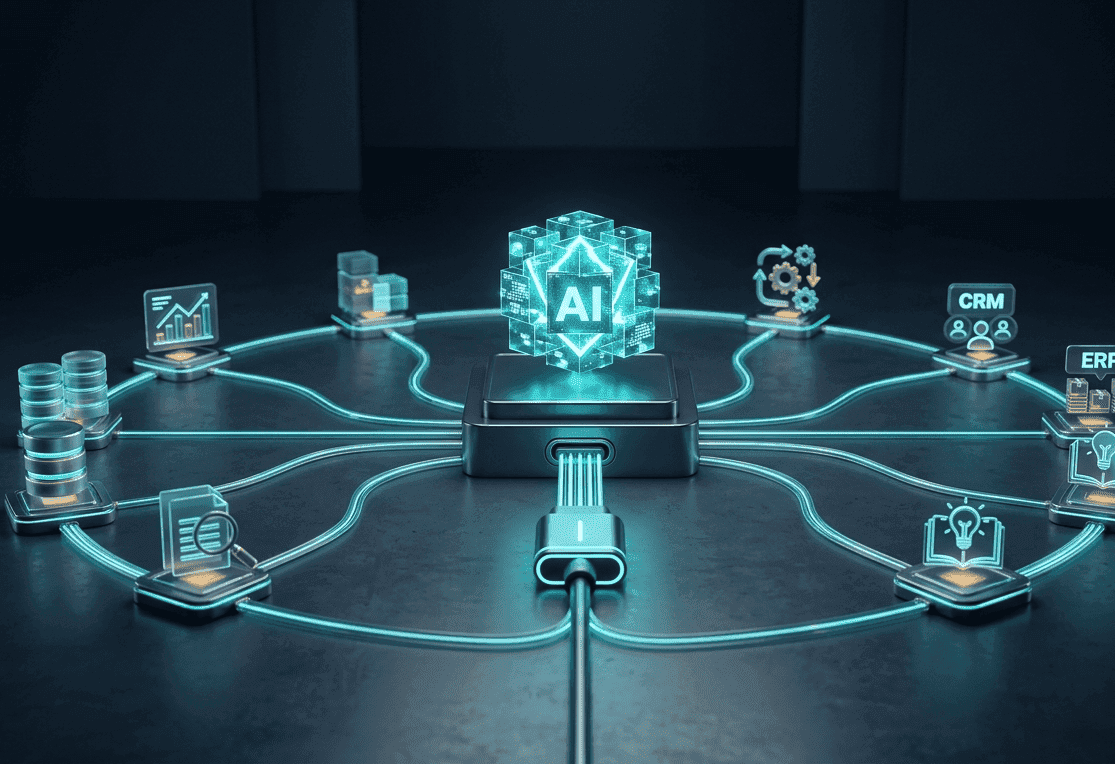
The Model Context Protocol is an open source initiative designed to allow AI applications to securely and easily exchange data with external tools and data sources. Think of it as the USB-C of AI integration. Before MCP, every developer had to build custom "glue code" to link an AI to a specific database or API.
By 2026, we expect MCP to be the industry standard for AI integration architecture. It allows developers to create "servers" that expose specific data or functionality, which any MCP-compatible "client" (like a large language model) can then consume without manual configuration.
| Table 1: Evolution of AI Integration Paradigms | ||
| Feature | The Legacy Way (Pre-2024) | The MCP Way (2026 Standard) |
| Connector Type | Bespoke API Integrations | Universal MCP Servers |
| Dev Effort | High (Weeks of "Glue Code") | Low (Plug-and-Play) |
| Portability | Model-Locked | Model-Agnostic |
| Data Access | Scheduled Batch Uploads | Real-time Context Injection |
The Strategic Value of MCP for Your CTO AI Strategy
In 2026, a winning CTO AI strategy prioritises flexibility. The chief technology officer now operates as a cross-functional strategist, not only a platform owner, and in 2025 many tech leaders will wear multiple hats well beyond traditional duties. The rate of model improvement is so high that locking your company into one vendor's ecosystem is a strategic risk. MCP provides an abstraction layer that protects your engineering team from the churn of the platform wars.
An effective executive AI stack aligns business goals with technical capabilities.
We advocate for the "Build Once, Connect Everywhere" philosophy. When your internal data science teams develop new insights via AI data science, they can expose those findings through an MCP server. This immediately makes that data available to every AI-powered department in your company, from customer support to R&D, but AI strategies only succeed when they are tied directly to business goals.
Reducing Tech Debt Through Standardisation
One of the most persistent issues in software development is the accumulation of tech debt from temporary fixes. In the rush to implement AI, many firms built thousands of fragile Python scripts to feed PDF data into LLMs. This is unsustainable. The real opportunity in ai adoption is to redesign workflows for business outcomes, not just layer on more technology.
MCP cleans up this mess. By standardising the AI integration architecture, you ensure that every part of your stack speaks the same language. This leads to cleaner codebases and faster onboarding for new engineers who join your dedicated team. When you expose those findings through an MCP server, a major CTO goal is to redesign workflows so the operating model can scale across business units.
Improving Time-to-Market for AI Products
Speed is the primary currency for startups. If your competitor can integrate a new data source into their AI chatbot in an afternoon while your team takes two weeks, you will lose market share. MCP facilitates rapid prototyping, and early adopters have seen it increase AI tool usage, because the ecosystem of pre-built MCP servers is expanding daily alongside managed solutions and SDKs that help teams implement MCP architecture quickly and standardize ai features.
Instead of writing a Jira integration from scratch, you simply pull the existing MCP server for Jira. Your AI model can then immediately "see" tickets, comments, and sprint statuses, which shortens ai development cycles while keeping ai capabilities aligned with product needs. This focus on speed is why we integrate these standards into our AI native pod delivery model.
Architectural Deep Dive: How MCP Functions
At its core, MCP operates on a client-server relationship and serves as a standardized integration layer for large language models to connect ai with internal systems such as a PostgreSQL database, a Slack workspace, or a local file system. The client is the interface the ai systems use to interact with that data.
The protocol handles the heavy lifting of discovery, permissioning, and data formatting. This means the AI doesn't just receive a raw dump of text; it understands the structure of the data it is accessing, and the same pattern also allows AI models to access external tools and data sources.
Key Components of MCP Architecture
- MCP Hosts: Tools like IDEs or enterprise dashboards that run the AI and initiate connections.
- MCP Clients: The protocol implementation within the host that communicates with servers.
- MCP Servers: Lightweight programmes that expose specific capabilities (e.g., searching Google, reading GitHub, or querying a private CRM), and many teams place centralized AI gateways in front of them to manage authentication and execution policies for AI agents.
- Resources: Static data that the model can read (like log files or documentation).
- Tools: Executable functions the model can trigger (like "Run Test Suite" or "Send Email").
This is also where agentic AI governance starts: the surrounding stack must be secure, observable, and adaptable so agents connect through a controlled layer rather than directly to every system.
The MCP Workflow
- The user sends a prompt to the AI Host.
- The Host identifies which MCP Servers are active.
- The Host's MCP Client requests a list of available Tools and Resources from the Servers.
- The AI Model decides which Tool or Resource is needed to answer the user's prompt.
- The MCP Client executes the request and returns the data to the Model.
- The AI Model generates a grounded response for the user.
// Example: Conceptual MCP Server Config
{
"mcpServers": {
"enterprise-db": {
"command": "npx",
"args": ["@startup-house/mcp-postgres-connector"],
"env": {
"DATABASE_URL": "postgresql://..."
}
}
}
}
The Future of AI Integration in 2026: Beyond Chatbots
By 2026, we will have moved past the "chatbot" phase. As of 2025, 62% of organizations are experimenting with AI agents. The future is Agentic Workflows—autonomous systems that can plan and execute multi-step tasks across different software applications. MCP is the glue that makes this possible.
An agent doesn't just talk about work; it does work. It can investigate a bug report in Jira, pull the relevant code from GitHub, check the latest logs in AWS via your cloud services, and suggest a fix. This is where ai assistants become operational systems rather than isolated tools, and many organizations are planning around that shift. By 2026, 80% of enterprises are expected to use generative ai, and 87% of organizations see AI as part of future success. Without a protocol like MCP, building this level of cross-tool integration would require a massive, impossible-to-maintain codebase.
High-Fidelity Contextual Awareness in AI Systems
The "black box" nature of early LLMs is a major hurdle for industries like fintech and health tech. Decision-makers need to know exactly why an AI made a specific recommendation. As AI now influences high-level strategy and decision making, that raises the bar for explainability.
MCP provides a clear audit trail of which resources were accessed during a session. This transparency is vital for compliance and debugging. In 2025, 95% of business executives reported AI-related incidents. It also helps establish model lineage, ensuring that AI integration architecture is not just powerful, but also observable and governable. And with 86% expecting agentic AI to heighten risk further, auditability and governance only become more critical.
Dynamic UI Generation with MCP
We are also seeing the rise of the AI interface layer. About 30% of users value MCP for providing better real-time context for AI models, especially when teams need real time data in the moment. Instead of static dashboards, MCP allows the AI to pull in the exact data visualisations needed at that moment.
If you ask an AI about sales trends in natural language, it can use an MCP tool to fetch data, generate insights, and then instruct the UI to render a specific chart component. This level of dynamic interaction will be the standard for high-end digital products in 2026.
Practical Challenges and Risks of Adopting MCP
While we are bullish on MCP, it is not a silver bullet. CTOs must navigate several challenges to implement it successfully across internal operations. The biggest risk is Security Scoping. If an MCP server has too much permission, unrestricted agent access to databases is a major security risk in AI systems, and an AI agent could inadvertently delete critical data or leak sensitive information.
You must implement strict "human-in-the-loop" confirmations for destructive actions and maintain clear loop control. Additionally, the performance overhead of calling multiple MCP servers can introduce latency. Optimising these calls is where high-quality quality engineering becomes essential. Many CTOs also face cultural and technical challenges during AI implementation.
Addressing the "Prompt Injection" Threat
As AI gains more access to your tools via MCP, the risk of prompt injection increases. An attacker could send a malicious email that, when read by an MCP-enabled agent, triggers a "Send Data" tool.
To mitigate this, we recommend:
- Credential Isolation: MCP servers should run with the minimum viable permissions.
- Tainting Analysis: Tracking where data comes from and preventing untrusted data from triggering sensitive tools.
- Monitoring: Real-time logging of all MCP tool calls to detect anomalous behaviour.
The Financial Argument: Why MCP Saves Money
Building custom AI integrations is expensive. The initial development cost is high, but the maintenance cost is higher. Every time an external API changes, your engineers have to refactor your integration code.
As of 2025, only 50% of AI initiatives created value, which is why integration efficiency and maintainability matter beyond technical metrics.
By using MCP, you shift that maintenance burden. The community or the service provider maintains the MCP server, and your application simply consumes it. This reduces tech debt, supports cost savings, and allows your team to focus on building features that actually differentiate your product.
Resource Allocation and Efficiency
In most startups, senior engineers spend up to 40% of their time on "plumbing"—moving data from point A to point B. MCP automates this plumbing. For a CTO, this means you can reallocate your most expensive talent to high-value tasks like product discovery and core IP development.
Consider the impact on your MVP timeline. At Startup House, we’ve seen that using standardised protocols can reduce the development cycle for AI-powered features by up to 30%. This speed-to-market is the difference between securing your Series A or running out of runway.
Real-World Application: MCP in Action
Let’s look at a hypothetical scale-up in the logistics sector. They have a massive amount of fragmented data: shipment tracking in one database, customer emails in another, and weather data from an external API.
Historically, they would build a "Data Warehouse" and then try to train a model on that data. This is slow and the data is always slightly out of date.
With MCP, the company can:
- Deploy an MCP Postgres Server to query shipment data in real-time.
- Connect an MCP Gmail Server to read the latest customer queries.
- Plug in a Google Maps MCP Tool to calculate delays.
In practice, 78% of enterprise AI teams now use MCP-backed agents in production, which makes this workflow realistic rather than hypothetical. That shift also reduces reliance on custom connectors and helps teams make more data driven decisions across operations.
The AI can now answer a complex question like: "Which shipments are likely to be delayed by the storm in the North Sea, and have we notified the affected customers?" and it can do so using the absolute latest data from every system.
Transitioning Your Team to an MCP-First Mindset
Adopting MCP requires more than just installing libraries; it requires a shift in how your team thinks about data access. Instead of thinking "How do I fetch this data?", they should think "How do I expose this data so the AI can use it?"
Start by auditing your current AI initiatives. Are you building proprietary connectors? If so, stop. Look for existing MCP servers or build your own internal MCP servers that can be reused across different projects. This modularity is the key to scalability.
Training and Skill Development
High-end software craftsmanship in 2026 will require proficiency in protocol-based integration. We recommend your team explores the official MCP documentation and starts experimenting with open-source hosts.
If you need to accelerate this transition, our team augmentation services can provide specialists who are already fluent in these emerging standards.
Frequently Asked Questions
What is the difference between MCP and a traditional API?
A traditional API is a structured way for two software programmes to talk to each other. Traditional integrations also often required custom code for each connection, whereas MCP is a layer on top of that, specifically designed for AI models. MCP handles the "negotiation" between the model's intent and the tool's execution, making it much easier for an LLM to understand what an API does and how to use it correctly without manual prompt engineering.
Is MCP only for Claude and Anthropic?
No. While it was initiated by Anthropic, MCP is an open standard. By 2026, we expect all major model providers (including OpenAI and Google) and most enterprise IDEs to support it. The goal is complete interoperability across the entire AI ecosystem.
How does MCP improve AI security?
MCP improves security by formalising the connection between models and data. It allows for more granular control over what an AI can see and do. That stronger control also supports risk reduction as organizations scale AI access. Instead of giving an AI a broad API key that can do anything, you can give it access to an MCP server that only exposes specific, read-only functions.
Can I use MCP with my existing legacy databases?
Absolutely. In fact, this is one of the strongest use cases. You can write a small MCP wrapper around a legacy SQL database or even a mainframe terminal. This allows your modern AI tools to interact with your oldest, most valuable data without needing a massive migration project.
Will MCP replace RAG (Retrieval-Augmented Generation)?
MCP doesn't replace RAG; it professionalises it. Currently, most RAG implementations are custom-built and difficult to maintain. MCP provides a standardised way to perform the "retrieval" part of RAG, making your retrieval logic more robust and easier to swap between different vector databases or search engines.
What are the first steps a CTO should take toward MCP integration?
Start by identifying one high-value internal data source that your AI currently can't reach. Build a simple MCP server for it. Observe how much more useful your AI tools become when they have that live context. Once you prove the value, note that significant portions of technical professionals expect their AI tool usage to involve MCP by 2026, which makes standardising on it early table stakes, then start mandating MCP for all new internal data services to ensure future AI integration architecture remains unified.
Building the Future with Startup House
The shift toward MCP and the Future of AI Integration: What CTOs Need to Know in 2026 is already underway. For tech leaders, MCP is quickly becoming table stakes for scalable AI integration rather than an experimental add-on. Those who embrace this protocol now will enter 2026 with a massive advantage: a flexible, secure, and highly efficient AI stack that isn't beholden to any single vendor.
At Startup House, we specialise in navigating these architectural shifts. Whether you are building an MVP or scaling an enterprise platform, we ensure your tech stack is built on modern, resilient standards that support measurable business outcomes, not just more sophisticated models. Let’s build an AI integration strategy that stands the test of time.
Ready to future-proof your product? Get in touch with us today to discuss how MCP can transform your development roadmap and drive real business value.
Digital Transformation Strategy for Siemens Finance
Cloud-based platform for Siemens Financial Services in Poland

You may also like...
Adding AI To Your Existing Platform Without Rewriting The Core
You don't need to rebuild your platform to make it intelligent. This guide shows how modular integration, API-first patterns, and shadow deployments let you add AI to a legacy system without touching the core.
Alexander Stasiak
Jun 28, 2026・12 min read

The Role of a CTO — Chief Technology Officer
The Chief Technology Officer is no longer just the senior engineer with the biggest title — they are the executive who turns technology into business value, revenue, and competitive advantage. From writing early code in a 20-person startup to setting AI governance in a global enterprise, the CTO role spans technology strategy, platform architecture, security, team leadership, and budget decisions. This guide breaks down what CTOs actually do, the skills that separate good from great, how the role differs from CIO and CPO, and the realistic 12–20 year career path to get there.
Alexander Stasiak
Apr 06, 2026・13 min read

AI Integration with Legacy Systems: A Practical 2026 Modernization Playbook
The question is no longer whether your organization should use AI. The question is how quickly you can integrate AI with the systems that actually run your business—most of which were built before smartphones existed.
Alexander Stasiak
Feb 22, 2026・13 min read
Ready to centralize your know-how with AI?
Start a new chapter in knowledge management—where the AI Assistant becomes the central pillar of your digital support experience.
Book a free consultationWork with a team trusted by top-tier companies.