The Real Cost Of Helpdesk Overload (And How AI Can Reduce It)
Alexander Stasiak
Jul 24, 2026・12 min read
Table of Content
Key Takeaways
Understanding the Hidden Financial Burden of Inefficiency
The Breakdown of Support Expenses
What Exactly Is Helpdesk Overload and High Ticket Volume?
The Architectural Shift: How AI Powered Support Reduces the Load
The Power of Intent Recognition
Real-World Impact: Proactive vs Reactive Support
Implementation Framework: From Chaos to Control
Measuring the ROI of AI Automation
Comparing Performance Metrics
Common Pitfalls in Human-AI Handoffs
Advanced Insights: Moving Beyond the Chatbot
Frequently Asked Questions
What is the primary cause of helpdesk overload in scaling startups?
How does AI helpdesk automation lower the cost per ticket?
Is AI support safe for industries with sensitive data?
Can AI handle complex technical troubleshooting?
What is the typical timeline for implementing AI support?
Will AI replace my human support team?
In the high-stakes environment of scaling a digital product, the helpdesk often becomes the victim of its own success. As your user base grows, the volume of inquiries scales linearly—or sometimes exponentially—while your support team’s capacity remains fixed by the constraints of headcount and human endurance. This friction creates a bottleneck that threatens to stifle growth and erode the user experience you worked so hard to build.
The Real Cost of Helpdesk Overload (And How AI Can Reduce It) is not merely a line item on a balance sheet; it is a systemic drain on company resources, morale, and brand equity. When support ticket volume exceeds a team’s operational threshold, the resulting "tech debt" in customer service manifests as slow response times and recurring errors. Traditional scaling methods, such as aggressive hiring, are often too slow and prohibitively expensive for startups aiming for lean efficiency.
Modern engineering offers a different path. By leveraging AI services, founders and product owners can transform their support infrastructure from a reactive cost centre into a proactive value driver. This shift requires a move away from legacy manual workflows toward an architecture where AI helpdesk automation acts as the first line of defence, resolving routine queries and freeing human experts for complex problem-solving.
Key Takeaways
- Indirect Costs: Overload leads to high employee turnover and increased churn, which often outweigh the direct customer support cost.
- Deflection Strategy: AI can successfully deflect up to 70% of routine inquiries through intelligent self-service and automated workflows.
- Operational Speed: Implementing an AI Interface Layer reduces First Response Time (FRT) from hours to seconds.
- Data Integrity: AI-driven systems provide superior sentiment analysis and trend reporting, allowing product teams to fix bugs before they generate tickets.
- Scalability: Unlike human teams, AI capacity can be increased instantly without recruitment cycles or training overhead.
- Customisation: Building an MVP development for AI support ensures you address specific user pain points rather than using generic chatbots.
Understanding the Hidden Financial Burden of Inefficiency
Most CTOs and founders calculate customer support cost by simply adding salaries to software subscriptions, but the true cost or total cost of support also includes hidden support costs such as software spend, process drag, and management overhead. This is an oversimplification that ignores the massive "invisible" expenses associated with a stressed helpdesk. When employees are overwhelmed, the quality of service drops, reducing service quality and customer satisfaction, hurting team efficiency, and making it harder to achieve real cost savings or lower costs.
One of the most significant hidden costs is Employee Attrition. In a helpdesk under siege, burnout is inevitable, and labor costs already consume a large share of the budget because agent salaries typically account for 60-80% of total support costs. Replacing a helpdesk agent can cost upwards of $12,000 once recruitment and training are included. If your team turns over every six months due to overload, you are effectively burning capital that should be invested in product innovation, while damaging employee experience for the remaining support staff.
Furthermore, there is the Reputational Tax. In a world of public reviews and social media, slow support hurts client retention and brand reputation. Potential customers who see complaints about "non-existent support" will opt for a competitor, leading to lost Lifetime Value (LTV) that never appears on a support budget report but deeply impacts the bottom line.
The Breakdown of Support Expenses
| Expense Category | Manual Support Model | AI-Augmented Model |
| Direct Labour | High: Linear growth with ticket volume | Low: Fixed cost for AI, stable human head-count |
| Infrastructure | Scaling CRM seats & telephony | API usage & cloud storage costs |
| Training | Continuous 4–6 week onboarding | One-time LLM fine-tuning & RAG setup |
| Churn Impact | High due to slow response times | Low due to 24/7 immediate assistance |
What Exactly Is Helpdesk Overload and High Ticket Volume?
Helpdesk overload occurs when the support ticket volume entering a system consistently exceeds the team's maximum output capacity. It is a state of operational insolvency where the "backlog" grows faster than it can be cleared. This isn't just a busy day; it’s a structural failure in the support pipeline, and overloaded teams often still depend on manual triage of incoming requests, which leads to longer resolution times.
In technical terms, this often results in Queue Latency. As tickets pile up, the "First Response Time" (FRT) and "Mean Time to Resolution" (MTTR) increase. Users become frustrated by the silence, often sending follow-up messages or opening new cases across different channels; that repeat contact volume often signals unresolved issues, and repeat tickets are a strong sign the root problem still hasn't been fixed.
How do you identify this threshold? Because contact rate per customer is often more useful than total volume alone, we look for specific indicators:
- Agent Occupancy: If agents are spent at 90% or higher capacity for sustained periods, quality will plummet; 56% of IT staff report rising ticket volumes and subsequent burnout.
- Context Switching: High ticket volume can reflect either more customers or unresolved product issues, and it forces agents to jump between dozens of unresolved issues, increasing tech debt in documentation and resolution accuracy.
- Escalation Rate: When basic tickets take too long, they are escalated to senior engineers, pulling expensive developers away from building the product, while excessive helpdesk requests inflate labor costs and slow down operations.
- Throughput: Falling tickets resolved per agent over time is a clear sign capacity is being outpaced.
The Architectural Shift: How AI Powered Support Reduces the Load
To solve overload, we must stop treating AI as a "glorified FAQ" and start treating it as a core component of your technical architecture. We integrate AI through an AI Native Pod approach, ensuring the automation is deeply connected to your product’s data and logic layers.
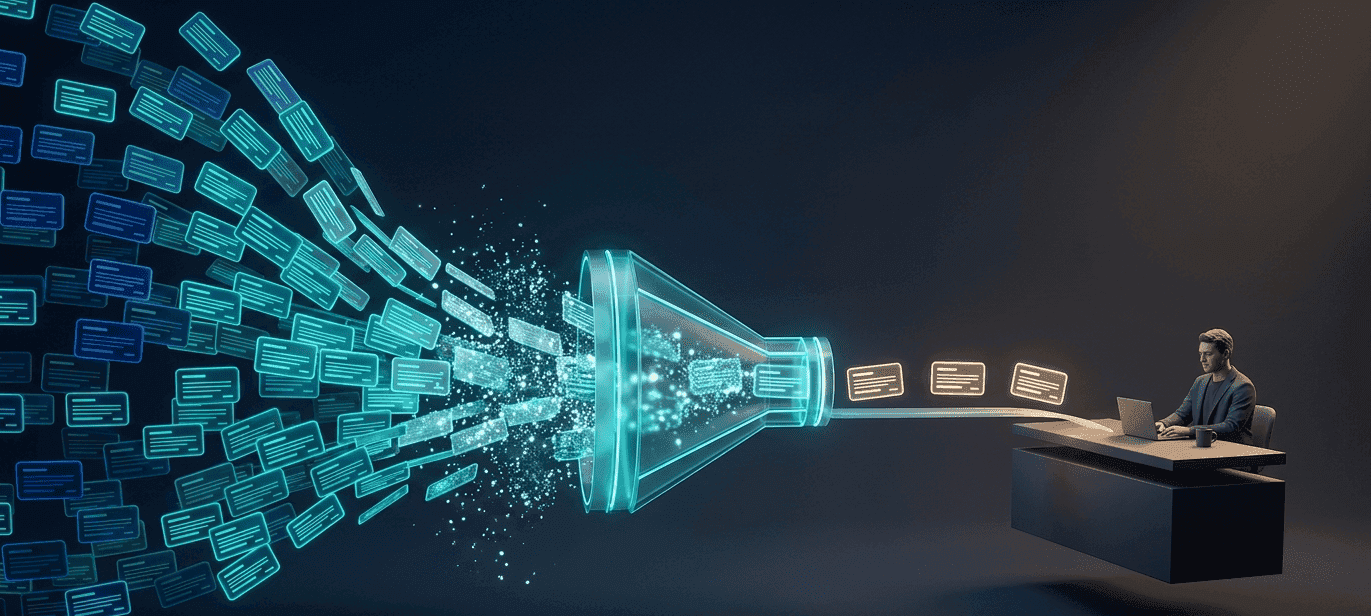
AI helpdesk automation functions through three primary mechanisms: Semantic Search, Intent Recognition, and Autonomous Resolution. In a legacy system, a user asks a question, and an agent searches a knowledge base. In an AI-driven system, the AI uses conversational ai powered by natural language processing and natural language understanding to interpret intent, ground answers in knowledge base articles, categorize incoming requests through ticket classification, and automatically apply the correct tags and priority levels. It also uses intelligent routing to send each case to the right agent, which can reduce ticket misrouting by 30-40%. This ai powered support model helps resolve issues faster and reflects how artificial intelligence improves ticket classification accuracy and efficiency.
This goes beyond simple chat. Advanced AI can perform actions. Through secure API integrations, an AI can provide instant resolutions for routine issues using natural language, and it can handle routine tasks like password resets or trigger a refund workflow; relying on human labor for these low-risk actions is expensive. In practice, AI can resolve 30% to 60% of common inquiries instantly without human intervention. This reduces the customer support cost by shifting the workload from "human-active" to "system-passive."
The Power of Intent Recognition
Most support tickets fall into the "Tier 1" category—repetitive, low-complexity queries. By training models on your historical data, we can classify these intents with over 95% accuracy. These ai features are not just reactive automation; they function as workflow automation embedded in ITSM-style support processes, and AI-driven ITSM tools can predict issues and recommend optimizations before incidents occur. If the AI detects a "payment failure" intent, it immediately checks the billing logs via an internal integration and provides a specific solution, rather than a generic "check your card" response; in deployment-bug cases, advanced AI can also monitor telemetry and analyze logs to detect anomalies, spot performance degradation, and trigger maintenance to prevent outages before issues escalate.
By delegating these "micro-tasks" to a machine, you allow your human team to focus on "Tier 3" issues—complex, high-value interactions that require empathy, nuanced judgement, or creative troubleshooting. This is where your human talent provides the highest ROI.
Real-World Impact: Proactive vs Reactive Support
One of the greatest advantages of AI is the transition from reactive to proactive support. By using Data Science to analyse ticket trends in real-time, the system can alert you to emerging product issues before they bloom into a crisis, which matters not only for user experience but also because heavy workloads hamper proactive threat management in IT support.
Imagine a scenario where a recent deployment causes a bug in the "export" feature. Within minutes, the AI notices a spike in support ticket volume, which can reflect either growth in customers or an underlying product problem. It doesn't just answer the users; it flags the anomaly to the engineering team and gives IT teams the context they need to intervene quickly, while automatically updating the frontend with a "we are aware of this issue" banner. This stops the flood of tickets at the source.
Our work on the Chooose case study demonstrates how high-quality engineering and data integration can streamline complex user paths. When the technical foundation is robust, individual support interactions become smoother, shorter, and more effective.
Implementation Framework: From Chaos to Control
- Audit the Backlog: Use natural language processing to categorise your last 10,000 tickets. Identify the 20% of issues causing 80% of the volume, and track how many tickets resolved by category are driving cost.
- Build the Knowledge Graph: Feed your knowledge base articles, Slack logs, and previous resolutions into a Vector Database.
- Deploy a Private LLM: Use a secure, private instance (via Azure or AWS) to ensure GDPR compliance and data privacy.
- Human-in-the-loop: Implement a "Confidence Score" system. If the AI is less than 85% certain of an answer, AI agents pass it to human agents with a drafted summary.
- Iterate: Use feedback loops to refine the AI’s responses daily based on agent corrections; generative AI can also create request summaries to improve ticket handling efficiency.
Measuring the ROI of AI Automation
For founders, the decision to invest in AI must be rooted in tangible outcomes. We focus on metrics that directly correlate with business health. Reducing support ticket volume is a vanity metric if those customers leave anyway; the goal is high-quality resolution at scale.
Consider the Cost Per Ticket (CPT). In a manual environment, CPT often ranges from £10 to £25, and manual ticket handling costs an average of $22 per interaction. With AI automation, the marginal cost of a resolved ticket drops to pennies, and AI can resolve up to 22% of service desk tickets at near-zero cost. When you project this over a year of growth, the savings often cover the initial development costs within months and materially lower total support costs, helping teams reduce costs through clear efficiency gains.
Another critical metric is Time to Resolution. In industries like fintech or healthcare, where we have extensive experience (see our Fintech and Healthtech services), speed is a compliance and safety issue. AI can improve first-contact resolution rates by 35% and improve resolution times by up to 75% in technical support. That helps teams deliver faster service by ensuring urgent queries are identified and prioritised instantly, protecting both the user and the company.
Comparing Performance Metrics
| Metric | Without AI Automation | With AI Automation |
| Availability | Business Hours (9-5) | 24/7/365 |
| Avg. Response Time | 4 - 24 Hours | < 30 Seconds |
| Resolution Rate (Tier 1) | 100% Human-dependent | 60-80% AI-Autonomy |
| Employee Morale | Low (Burnt out) | High (Focused on strategy) |
Common Pitfalls in Human-AI Handoffs
The most common mistake startups make is treating AI as a replacement for humans rather than an augmentation. If a user is frustrated and the AI gives a circular, unhelpful answer, you have just magnified their anger, and poorly designed self-service updates can increase user frustration instead of reducing it. This is where Quality Engineering becomes vital.
A "fail-safe" handoff mechanism is non-negotiable. If the AI detects sentiment markers indicative of frustration or high-value accounts (VIPs), it must immediately escalate to a live agent. The agent should receive a summary of the AI's conversation; AI also generates request summaries to improve ticket handling efficiency for human agents. This "warm transfer" preserves the user's dignity and time while protecting customer satisfaction.
Another risk is Data Hallucination. Generic AI models sometimes "make up" answers when they lack data. We prevent this by using strict RAG (Retrieval-Augmented Generation) architectures that force the AI to cite sources within your official documentation. If the information isn't in the documentation, the AI is programmed to say, "I'm not sure, let me get a specialist to help you."
Advanced Insights: Moving Beyond the Chatbot
The future of helpdesk efficiency lies in Multimodal AI. This means the system can process more than just text. If a user uploads a screenshot of an error, the AI uses Computer Vision to read the error code and look up the specific server log associated with that user's session ID. Framed as ai powered support, an ai chatbot can work across channels, and generative ai expands these systems beyond simple scripted support.
This level of integration requires a sophisticated Platform Engineering strategy. It isn't just about an "AI helpdesk automation" tool; it's about an interconnected ecosystem where your support, engineering, and product data flow seamlessly. By 2025, 80% of customer interactions are projected to be handled by AI agents, which is why platform-level integration matters. This holistic view is exactly what we provide at Startup House.
Consider the impact on Tech Debt. When your helpdesk AI identifies that a specific UI element is causing 50 tickets a day, it doesn't just solve them; it generates a Jira ticket for the design team. This creates a virtuous cycle where support data directly informs product development, eventually eliminating the root causes of overload entirely.
Frequently Asked Questions
What is the primary cause of helpdesk overload in scaling startups?
Overload is primarily caused by linear scaling models where ticket volume grows faster than human hiring can keep pace. Often, a lack of self-service options and poor product onboarding lead to repetitive "Tier 1" inquiries that clog the system, though strong self-service options can resolve 60% of IT issues independently, and AI-driven chatbots can enable employees to resolve up to 60% of IT issues without joining the queue, improving the overall employee experience. That prevents agents from handling complex issues where they are most needed, and AI can reduce ticket volume by 25–45% through deflection of repetitive Tier 1 requests.
How does AI helpdesk automation lower the cost per ticket?
AI lowers the customer support cost by automating the resolution of high-volume, low-complexity queries. While a human agent can handle maybe 5-10 chats an hour, an AI can handle thousands simultaneously, and companies using AI report 25-45% fewer tickets reaching human agents, which is what changes the cost structure. This shifts the cost structure from variable labour expenses to a stable, predictable software investment.
Is AI support safe for industries with sensitive data?
Yes, provided it is built with enterprise-grade security. By using private cloud environments and strict data anonymisation protocols, we ensure that AI tools comply with GDPR, HIPAA, or other relevant standards. At Startup House, we prioritise technical depth to ensure security is "baked into" the architecture from day one.
Can AI handle complex technical troubleshooting?
AI is excellent at the first stages of troubleshooting—gathering logs, verifying settings, providing known solutions, and using natural language processing to deliver instant resolutions for routine technical issues before escalation is needed. For highly complex "edge cases" or brand-new bugs, AI serves as an agent assistant, surfacing documentation and suggesting steps to the human agent, thus reducing the time the human spends on research.
What is the typical timeline for implementing AI support?
We typically follow an MVP development approach. A functional AI integration that handles the top 20% of your ticket volume can often be deployed in 4–8 weeks for startups or mid sized teams, while large organizations usually need longer implementation cycles depending on data complexity and key features. From there, we iterate and expand into more complex workflows based on real-world performance metrics.
Will AI replace my human support team?
We view AI as a force multiplier, not about replacing people but about enabling support staff at a time when the IT and service support industry averages roughly a 40% turnover rate. AI handles the "boring" repetitive tasks that cause burnout, allowing your team to focus on high-impact customer success, relationship building, and complex problem solving. It also allows you to scale your business without doubling or tripling your support headcount, and AI can resolve 30% to 60% of common inquiries instantly without human intervention, freeing people for more complex work.
Managing the real cost of helpdesk overload requires more than just more people; it requires a smarter system. By integrating AI-driven automation, you protect your team's mental bandwidth, your company's capital, and your customers' trust. If you are ready to stop fighting fires and start scaling with precision, we are here to help you architect that future. Contact us today to discuss how we can transform your support operations.
How this article was made. Drafted with AI assistance, then fact-checked and edited by our team. Editorial responsibility: Startup Development House sp. z o.o. Read our AI content policy
Digital Transformation Strategy for Siemens Finance
Cloud-based platform for Siemens Financial Services in Poland

You may also like...
Recently added

Application Development Solutions
Application development solutions cover the entire arc from strategic discovery to continuous scaling, and each phase has its own failure modes. This guide defines what modern solutions include, explains why discovery deserves real investment, and shows where custom engineering beats generic templates. It reviews agile sprint execution, industry-specific requirements and the engagement models that fit different growth stages. Security, compliance and time-to-market trade-offs are treated as engineering concerns rather than afterthoughts.
Alexander Stasiak
Aug 22, 2026・8 min read

Application Development In Cloud Computing
Running an application in the cloud and building it for the cloud are very different engineering decisions. This guide covers cloud-native development properly: the delivery models, the container and orchestration stack, and the CI/CD pipelines that make continuous deployment safe. It walks the lifecycle step by step, addresses the challenges teams hit around cost control and vendor lock-in, and compares long-term economics against on-premise alternatives. Industry examples and forward-looking trends round out the picture.
Alexander Stasiak
Aug 21, 2026・8 min read

Software Engineering Service
Engineering is a discipline of measurable, repeatable practice, and that is what separates a service from simple contract coding. This guide sets out the pillars of high-performance software engineering: strategic discovery, architectural design, rigorous testing and lifecycle maintenance. It compares cooperation models, explains how to choose a technology stack that suits your constraints, and walks a project from ideation to scale. A closing section looks at how AI is reshaping engineering practice itself.
Alexander Stasiak
Aug 20, 2026・7 min read

Software Programming Services
Programming services are only as valuable as the architecture and process wrapped around them. This guide sets out the pillars of high-impact programming, how to choose a technology stack, and the delivery models that have replaced simple hourly billing. It follows the lifecycle of a programming project, covers infrastructure and platform engineering, and reviews vertical-specific expertise. Advanced trends, common outsourcing pitfalls and a method for calculating ROI complete the guide.
Alexander Stasiak
Aug 19, 2026・9 min read
Application Outsourcing
Outsourcing applications is a governance problem as much as a sourcing one. This guide explains the strategic value of application outsourcing, compares the core engagement models, and covers stack selection and industry-specific requirements. It follows the outsourcing lifecycle from discovery through scaling, then examines the economics honestly, including where apparent savings turn into rework. Sections on engineering culture, platform engineering and the effect of AI on outsourcing close the picture.
Alexander Stasiak
Aug 18, 2026・9 min read

Custom Enterprise Application Development Services
Once an organisation outgrows off-the-shelf software, the question becomes how to build resilience rather than features. This guide explains why enterprises commission custom applications, and what modern architectural standards demand around scalability, security and interoperability. It follows the roadmap from discovery to deployment, reviews industry-specific applications, and addresses the integration and change-management challenges that make enterprise projects difficult. Practical answers to common questions close the guide.
Alexander Stasiak
Aug 17, 2026・6 min read
Ready to centralize your know-how with AI?
Start a new chapter in knowledge management—where the AI Assistant becomes the central pillar of your digital support experience.
Work with a team trusted by top-tier companies.


