8 Examples of Innovative Digital Transformation Case Studies

Table of Content
Digital transformation, an integration of digital technology into all areas of business, fundamentally alters how companies operate and deliver value to their customers. Here, we'll delve into eight illuminating digital transformation case studies that showcase how diverse businesses leveraged technology to achieve tangible outcomes.
1. Tesla:  Reshaping the Auto Industry
One of the most intriguing digital transformation examples is that of Tesla, an electric car company that revolutionized the automotive industry. Leveraging the latest technology such as cloud computing, Tesla uses connected car technology and over-the-air software updates to enhance the customer experience, enable cost savings, and reduce carbon emissions. This innovative approach has contributed to a significant decrease in fuel consumption and placed Tesla at the forefront of the electric cars market.
2. Netflix:  Reinventing Entertainment
Netflix's journey of digital transformation is no less extraordinary. It transformed the entertainment industry by offering on-demand subscription-based video services to its customers. Using advanced analytics, mobile apps, and a customer-centric approach, Netflix set the gold standard in meeting digital customer expectations.
3. Baystone Media: Driving Product Adoption in Healthcare
Baystone Media, a subsidiary of Internet Brands®, turned to Whatfix DAP to drive product adoption of its healthcare businesses. This digital transformation initiative led to streamlined workflows, enhanced order reporting, and increased customer satisfaction.
4. Glassdoor: Revolutionizing Recruitment
Glassdoor is another digital transformation case that stands out. By providing a platform for employees to share experiences and insights, it significantly altered the dynamics of the labor market research and recruitment industries.
5. Under Armour: Turning Data into Success
Under Armour, initially an athletic apparel company, diversified into a new data-driven digital business stream to transform the fitness industry. They fully leveraged customers' personal health data, connected fitness trends, and utilized artificial intelligence to offer a seamless and improved customer experience.
6. Sophos: Streamlining Business with Salesforce
In another interesting digital transformation case, Sophos implemented Salesforce to streamline its business processes and manage customer relations more effectively. The deployment of new technology like Salesforce helped them optimize digital efforts, yielding benefits like better customer service and significant annual savings.
7. Audi City London: Boosting Sales Through Digital Innovation
Audi City London stands as an example of digital innovation. They employed digital technologies and a localized marketing strategy to create a unique customer experience, driving up sales and outperforming the overall market.
8. LEGO: Turning Around Through Digital Transformation
The story of LEGO’s successful digital transformation is one of the most inspiring. After a steady decline, the company rebounded thanks to an array of digital transformation initiatives. Their successful deployment of digital products, like mobile games linked to the first LEGO movie, resulted in achieved revenues and enhanced the customer's criteria of success.
9. Amazon's Digital Transformation:
Amazon faced fierce competition and profitability challenges in its early days. Rapidly changing digital customer expectations necessitated scaling while ensuring customer satisfaction and operational efficiency. Amazon launched Amazon Business in 2015, catering to B2B businesses with a diverse product range. They introduced features like free two-day shipping, exclusive price discounts, and integrated purchasing systems for a seamless B2B experience. Amazon successfully tapped into the $7.2 to $8.2 trillion B2B wholesale market in the US. Revenue generation through sales commissions and enhanced customer experience with customized products.
FAQs
1. What are some examples of digital transformation?
Examples of digital transformation include Tesla's use of connected car technology, Netflix's on-demand subscription model, and Under Armour's data-driven fitness strategy.
2. How does digital transformation enhance customer experience?
By leveraging digital technologies and tools, businesses can meet digital customer expectations, improve service delivery, and create personalized experiences.
3. What is a digital transformation strategy?
A digital transformation strategy refers to a plan that guides the overhaul of business processes, models, and corporate culture to fully leverage the changes and opportunities of digital technologies.
4. How does digital transformation affect business models?
Digital transformation enables companies to innovate their business models for improved customer engagement, optimized operations, and new revenue streams.
5. How does artificial intelligence contribute to digital transformation?
Artificial intelligence provides actionable insights, automates manual processes, and enhances decision-making, driving digital transformation.
6. What role does cloud computing play in digital transformation?
Cloud computing provides businesses with scalable, flexible, and cost-effective solutions, facilitating digital transformation.
7. Can you give an example of digital transformation in the healthcare industry?
Baystone Media's use of Whatfix DAP to drive product adoption in their healthcare businesses is a great example of digital transformation in the healthcare industry.
8. How does digital transformation help in cost savings?
Digital transformation can help automate manual processes, increase operational efficiency, reduce waste, and thereby lead to cost savings.
9. What is the impact of digital transformation on labor market research?
Digital transformation allows for real-time and precise labor market research, leading to more informed decision-making and strategy development.
10. How can digital transformation initiatives improve customer service?
Through digital transformation initiatives, businesses can offer personalized experiences, round-the-clock service, and seamless interactions, thereby improving customer service.
11. What are some examples of digital transformation in the energy industry?
The use of predictive maintenance and advanced analytics for optimized fuel consumption are examples of digital transformation in the energy industry.
12. How do digital technologies improve business processes?
Digital technologies can automate and streamline business processes, increase efficiency, reduce errors, and facilitate decision-making.
13. What are some examples of digital transformation in the manufacturing industry?
The use of automation, IoT, and predictive maintenance in the manufacturing process are examples of digital transformation in this sector.
14. How does mobile technology contribute to digital transformation?
Mobile technology allows businesses to reach customers on their phones, offering convenience, enhancing engagement, and facilitating transactions.
15. Can you give an example of digital transformation in the retail industry?
Audi City London's use of digital technologies to enhance customer experience and boost sales is an example of digital transformation in the retail industry.
16. What can we learn from successful digital transformation case studies?
Successful digital transformation case studies teach us the importance of aligning technology with business goals, the need for strong leadership, and the power of a customer-focused approach. They also highlight the necessity of agility and adaptability in a rapidly changing digital landscape.
17. How do successful digital transformation case studies impact industry trends?
These case studies often set trends in various industries by showcasing innovative uses of technology. They influence how other companies adopt and implement digital strategies, driving broader changes in industry practices and consumer expectations.
18. Can small businesses benefit from insights in successful digital transformation case studies?
Absolutely. Small businesses can learn valuable lessons from successful digital transformation case studies, such as how to efficiently use limited resources, the importance of scalability, and ways to enhance customer engagement through digital means.
19. What are some common challenges highlighted in successful digital transformation case studies?
These case studies often reveal challenges like resistance to change, integration of new technologies with legacy systems, and ensuring data security and privacy. They provide insights into how businesses can navigate these challenges successfully.
20. How do successful digital transformation case studies emphasize the role of data analytics?
Many successful digital transformation case studies underscore the importance of data analytics in understanding customer behavior, optimizing operations, and driving decision-making. They show how data can be a powerful tool in crafting a successful digital strategy.
21. What role does company culture play in successful digital transformation case studies?
Company culture plays a crucial role in these case studies. A culture that embraces change, fosters innovation, and supports continuous learning is often key to successful digital transformation efforts.
22. How do successful digital transformation case studies address customer experience?
These case studies typically focus on how digital transformation can enhance customer experience through personalized services, improved accessibility, and more engaging digital interactions.
23. What lessons on sustainability can be learned from successful digital transformation case studies?
Successful digital transformation case studies often include sustainability initiatives, demonstrating how technology can be used to reduce environmental impact and promote sustainable business practices.
24. What lessons on optimizing operations can be derived from successful digital transformation case studies?
In exploring successful digital transformation case studies, businesses can learn valuable lessons on optimizing operations. These case studies often showcase how digital technologies streamline processes, increase efficiency, and contribute to significant cost savings, ultimately leading to more effective and agile operational frameworks.
As we close our digital journey, let's remember that the power of digital transformation is not in the technology itself, but in how we use it to improve our world.
And here's a little digital transformation humor to end our journey:
Why don't digital transformers ever play hide and seek?
Because good luck hiding when you're always connected!
How this article was made. Drafted with AI assistance, then fact-checked and edited by our team. Editorial responsibility: Startup Development House sp. z o.o. Read our AI content policy
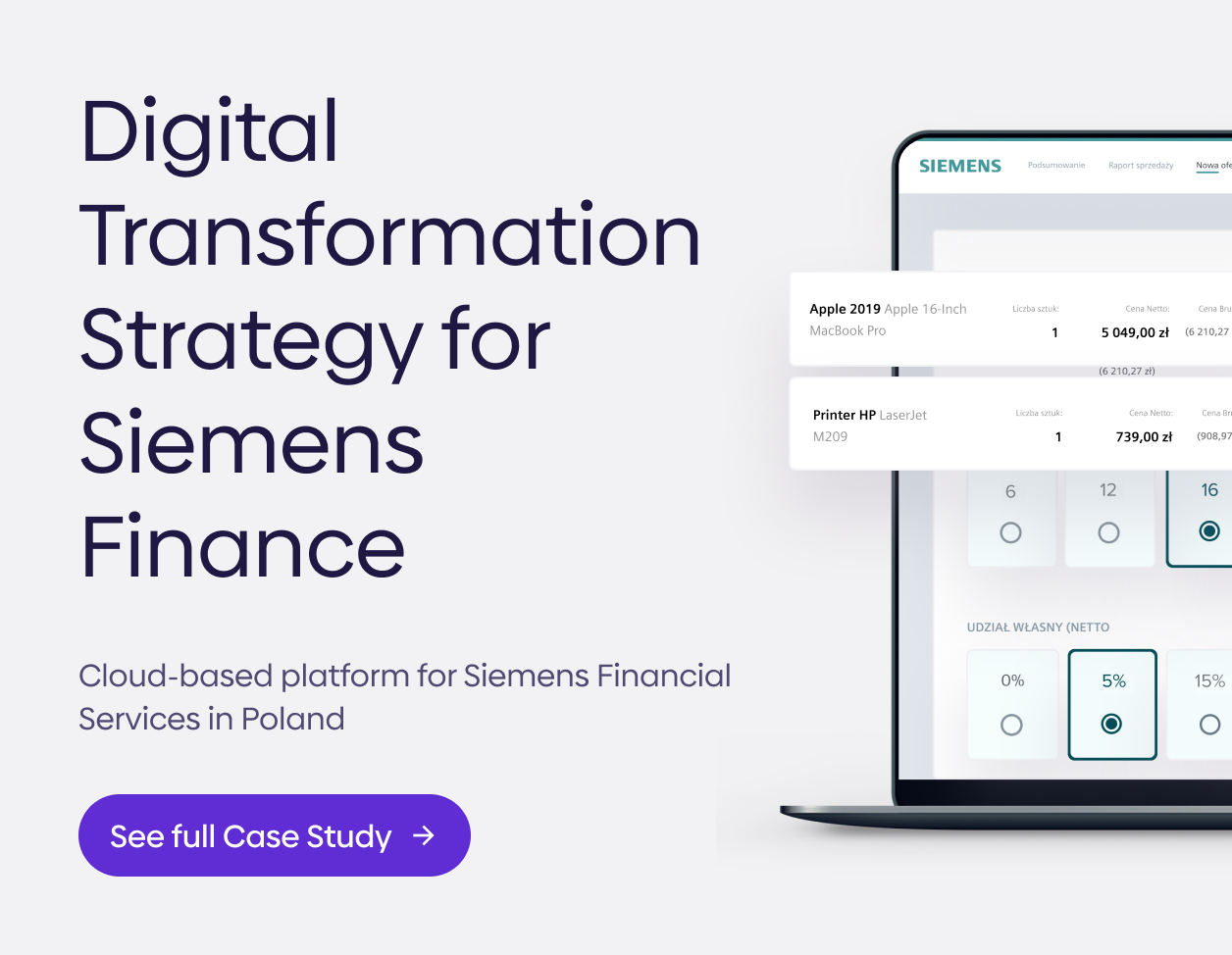
Digital Transformation Strategy for Siemens Finance
Cloud-based platform for Siemens Financial Services in Poland


You may also like...

Bridging the Gap Between Legacy and Innovation
Enterprise systems fail differently from consumer apps: the risk sits in integration, compliance and data volume rather than in features. This guide covers the architectural foundations of enterprise-scale software, including decoupled services, high-throughput data processing and secure integration with existing infrastructure. It examines how to modernise legacy platforms without halting operations, and where AI now adds measurable value inside large organisations. The closing sections address the pitfalls that most often derail transformation programmes.

Alexander Stasiak
Jul 04, 2026・7 min read

Custom Enterprise Software Development
Generic enterprise platforms solve generic problems, which is precisely why they struggle with the last mile of your operations. This guide explains when custom enterprise software becomes the rational choice, and what enterprise-grade architecture actually requires in terms of scalability, interoperability and security. It follows a build from discovery through deployment, shows where AI and data science create leverage, and compares cooperation models. Cost considerations and ROI logic are treated directly rather than glossed over.
Alexander Stasiak
Jul 13, 2026・8 min read

Enterprise Software Product Development
Enterprise products have to satisfy procurement, security review and end users simultaneously, which shapes every engineering decision. This guide sets out the pillars of enterprise product excellence, including security-first architecture, graceful scaling and integration depth. It walks the development lifecycle phase by phase, compares cooperation models, and reviews industry-specific enterprise solutions. Modern stack recommendations, known challenges and emerging trends complete the guide.
Alexander Stasiak
Jul 14, 2026・9 min read

Custom Enterprise Application Development Services
Once an organisation outgrows off-the-shelf software, the question becomes how to build resilience rather than features. This guide explains why enterprises commission custom applications, and what modern architectural standards demand around scalability, security and interoperability. It follows the roadmap from discovery to deployment, reviews industry-specific applications, and addresses the integration and change-management challenges that make enterprise projects difficult. Practical answers to common questions close the guide.
Alexander Stasiak
Aug 17, 2026・6 min read

Why Your Internal Knowledge Base Is Failing (And What To Do About It)
Siloed, outdated, and unsearchable documentation quietly drains your team's velocity every day. This article diagnoses why internal knowledge bases fail and lays out a practical roadmap using enterprise search, AI, and a document-first culture.
Alexander Stasiak
Jul 25, 2026・10 min read

Business Intelligence Implementation Services
Business intelligence fails most often at the pipeline, not the dashboard. This guide covers BI implementation as an engineering discipline: warehouse architecture on platforms like Snowflake and BigQuery, ELT pipeline design, data modelling standards and automated validation. It sets out the phases of a strategic implementation, the challenges that stall projects, and the monitoring that catches broken syncs before executives do. Future trends and partner selection criteria close the guide.
Alexander Stasiak
Aug 01, 2026・7 min read
Recently added

How Startup House Cut Leasing Applications to 2 Minutes for Siemens Financial Services
Leasing used to mean paperwork, manual credit checks, and decisions that waited for office hours. For Siemens Financial Services Poland, Startup House replaced that with SimplyLease Online: an application customers complete in about 2 minutes and an automated credit decision delivered in about 7, at any hour. This case study shows how the platform was built within Siemens Group security standards, how it connects to Siemens systems and external data providers, and what a partnership running since 2016 has delivered. It closes with three lessons that apply to almost any financing or lending product.
Alexander Stasiak
Oct 06, 2026・5 min read

How a Cybersecurity Platform Serving Fortune 500 Clients Cut Onboarding by 95% with an AI Agent Built by Startup House
A cyber risk platform trusted by Fortune 500 companies had a familiar problem: customers respected it but opened it once a quarter, and onboarding took 45 minutes of guided setup. Startup House built Aria, an AI agent embedded inside the product, with a four-layer interface that serves board members, CFOs, and CISOs in one panel. Onboarding dropped by 95% to under 2 minutes, data exploration became fully self-serve, and the platform turned into a daily decision-support tool. This case study explains the interface, the tenant-isolation architecture, and why none of it required touching the platform's core codebase.
Marek Pałys
Oct 05, 2026・5 min read

AI and Digital Projects by Startup House: 5 Measurable Outcomes in Numbers
Claims are easy in software development, so this article sticks to numbers. It walks through five outcomes from Startup House client projects, from a 95% cut in onboarding time with an embedded AI agent to a 40% reduction in development costs for Omnipack. Each section says what kind of work produced the number and links to the public case study behind it. The closing section names three patterns these projects share, worth borrowing whether or not you work with us.
Alexander Stasiak
Oct 04, 2026・5 min read

Healthtech Software Development at Startup House: Compliance-First Projects and Results
In healthcare software, compliance is either an architecture decision or a retrofit. This article shows what designing it in from day one looks like across three Startup House projects: a sales platform for Siemens Healthineers active in more than 60 countries, a dementia care MVP shaped by 7 user testing sessions with patients and caregivers, and Doogie, a HIPAA-grade AI showcase built in 2 months. It also explains how RAG keeps clinical AI answers traceable to verified sources, and why patient data is never used to train models. For MedTech companies and health SaaS platforms, it is a practical look at what compliance-first engineering means beyond the label.
Marek Pałys
Oct 03, 2026・5 min read

Edtech Development at Startup House: What We've Built and What It Changed
EdTech platforms fail for UX reasons more often than technical ones: learners drop off, content doesn't scale, and ROI stays invisible. This article shows how Startup House avoids that with phased delivery and real user testing, using two projects as proof. Graspify went from a bold idea to a microlearning platform that trained hundreds of employees during a corporate event, and LITTLEWINE got an investor-ready scope from 10 user interviews in 2 weeks. It also covers AI learning tools that answer only from approved content and can go live in as little as 2 weeks.
Alexander Stasiak
Oct 02, 2026・5 min read

AI in Fintech: Startup House Projects, Lessons, and Outcomes
Fintech customers expect consumer-grade speed, while regulators expect bank-grade control. This article shows how Startup House has handled that tension in three projects: automated 24/7 credit decisions for Siemens Financial Services, a cyber risk platform that grew revenue 150% in a year, and a climate fintech team for CHOOOSE assembled in 2 weeks. Each project comes with the lesson it taught us. The article closes with five rules for AI in finance, from grounding every answer in verified data to designing tenant isolation into the architecture.
Marek Pałys
Oct 01, 2026・5 min read
Ready to centralize your know-how with AI?
Start a new chapter in knowledge management—where the AI Assistant becomes the central pillar of your digital support experience.
Work with a team trusted by top-tier companies.


